
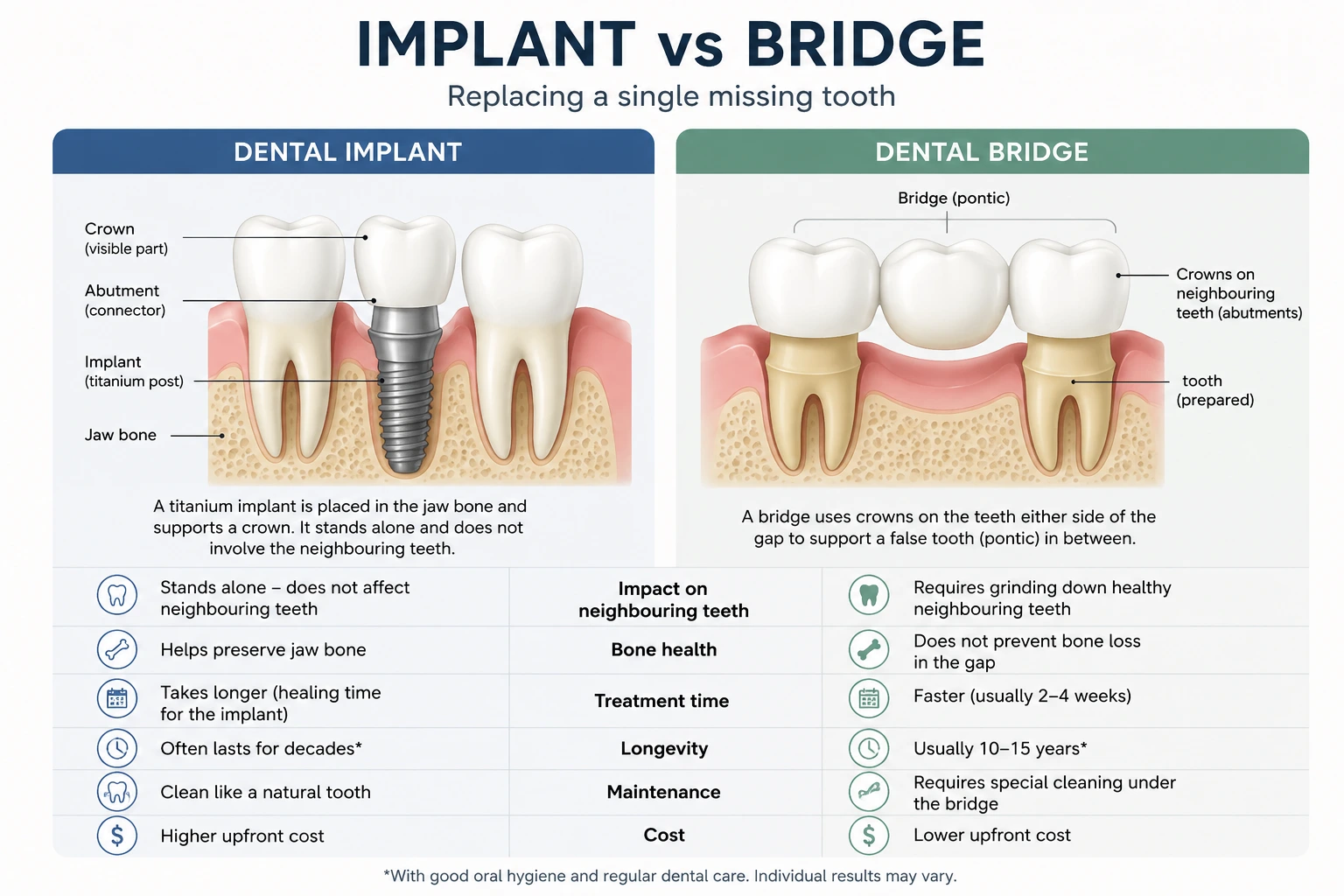
sWhen comparing dental implants vs bridges for replacing a single missing tooth, an implant is usually the better long-term value: it stands alone without touching the neighbouring teeth, helps preserve the jaw bone, and often lasts longer. A bridge costs less upfront and is faster, but it relies on grinding down the teeth either side and tends to need replacing sooner. The right choice depends on your bone, the health of the neighbouring teeth, your timeframe and your budget.
At a glance: Dental implants vs bridge
- Dental implants typically last longer than bridges.
- Implants help preserve the jaw bone after tooth loss.
- Bridges generally cost less upfront and can be completed sooner.
- Implants don’t require neighbouring teeth to be altered.
- The best choice depends on your oral health, treatment goals, and budget.
Both are good, well-proven options. Understanding how they differ across longevity,
maintenance and value helps you choose with confidence.
How each option works
A dental implant is a small titanium post placed in the jaw that fuses with the bone (osseointegration) and supports a crown a standalone replacement that doesn’t involve the neighbouring teeth.
A bridge spans the gap by placing crowns on the teeth either side (the abutment teeth) to carry a false tooth (the pontic) in between.
Dental implant: An artificial tooth root made from titanium that is surgically placed into the jawbone to support a replacement tooth.
Dental bridge: A fixed dental restoration that replaces a missing tooth by attaching an artificial tooth to neighbouring crowned teeth.
Implants vs Bridges
| Feature | Dental Implant | Dental Bridge |
|---|---|---|
| Treatment | Titanium implant with crown | Crown-supported false tooth |
| Surgery | Yes | No |
| Adjacent teeth affected | No | Yes |
| Bone preservation | ✔ Yes | ✖ No |
| Typical lifespan | Often decades* | Usually 10–15 years* |
| Cleaning | Similar to a natural tooth | Requires cleaning beneath the bridge |
| Treatment time | Several months | Usually 2–4 weeks |
| Initial cost | Higher | Lower |
| Long-term value | Often better | Depends on supporting teeth |
Longevity
Implants have a high long-term success rate and the post itself can last for decades with good
care; the crown on top may need renewing over time. Bridges are durable but generally have a
shorter average lifespan, because the supporting teeth remain vulnerable to decay and the
bridge takes on extra load. If one abutment tooth fails, the whole bridge usually needs replacing.
Clinical studies have consistently shown high long-term success rates for dental implants when they are placed in suitable candidates and maintained with good oral hygiene and regular dental reviews.
Maintenance and bone health
An implant is cleaned much like a natural tooth — brushing and cleaning around it daily, plus
regular professional maintenance to prevent peri-implantitis (gum inflammation around the implant). A bridge needs special cleaning underneath the false tooth using floss threaders or
interdental brushes, which some people find fiddly. Crucially, an implant stimulates the jaw bone
and helps prevent the bone loss that follows a missing tooth, whereas a bridge doesn’t preserve
bone in the gap — over years this can change the look of the area.
Dental Implants vs Bridges: Cost and value over time
A bridge typically has a lower upfront cost and is completed faster, which suits some situations
and budgets. An implant costs more initially and takes longer (healing time is needed for the
bone to integrate), but because it lasts longer, protects the neighbouring teeth and preserves
bone, its cost-per-year is often very competitive. We don’t quote prices online, but at your
consult we provide a written plan with clear costs and any health-fund considerations so you
can weigh value, not just sticker price.
Why are implants more expensive?
Dental implants involve several stages of treatment, including assessment, surgical placement, healing while the implant integrates with the bone, and fitting the final crown. Bridges usually require fewer appointments and no surgery, making them less expensive initially. However, because implants often last longer and preserve neighbouring teeth and bone, many patients consider them better long-term value.
Treatment Timeline
One factor many patients don’t consider is how long treatment takes.
A dental bridge can often be completed within two to four weeks, depending on whether the supporting teeth require additional treatment.
A dental implant usually takes several months, as the implant needs time to fuse with the jawbone before the final crown is placed. Although the process is longer, this healing period contributes to the implant’s long-term stability.
Other options worth weighing
Implants and bridges aren’t the only two paths. A removable partial denture is a lower-cost, non
surgical way to fill a gap and can suit some situations or act as a temporary while you decide,
though it’s less stable and many people find it less comfortable for everyday eating and
speaking. Doing nothing is also a legitimate choice for some back-tooth gaps — but it’s worth
understanding the trade-offs, because neighbouring teeth can tilt and drift into the space, the
opposing tooth can over-erupt, and the bone in the gap slowly shrinks, which can make
treatment more complex if you change your mind later.
At a consult we map out every realistic option for your specific gap — not just the two headline
ones — so the decision fits your priorities, whether that’s longevity, cost, avoiding surgery or
simply keeping things straightforward.
Who is a good candidate?
An implant may be suitable if you:
- have healthy gums
- have enough jawbone to support the implant
- want the longest-lasting solution
- wish to preserve neighbouring teeth
A bridge may be more appropriate if you:
- already need crowns on adjacent teeth
- prefer to avoid surgery
- need treatment completed sooner
- are looking for a lower upfront investment
Dental Implants vs Bridges: Things to consider
Every treatment option has advantages and limitations.
Dental implants:
- require a minor surgical procedure
- involve a longer treatment timeline
- may require bone grafting in some patients
Dental bridges:
- rely on neighbouring teeth for support
- do not prevent bone loss beneath the missing tooth
- may eventually need replacement if a supporting tooth develops problems
Discussing these considerations with your dentist helps ensure the treatment aligns with your long-term oral health goals.
Which is right for you?
• An implant often suits you if you have enough healthy bone, the neighbouring teeth are
intact, and you want the longest-lasting, most tooth-preserving option.
• A bridge may suit you if the neighbouring teeth already need crowns, if you can’t have
surgery, or if you need a faster or lower upfront-cost solution.
• If bone has already been lost, options like bone grafting or alternative designs can be
discussed.
Every mouth is different, so the best decision comes from an assessment of your bone, gums
and neighbouring teeth. Patients from Winmalee, Blaxland and across the Blue Mountains are
welcome to book a tooth-replacement consult to compare both options for their specific
situation.
At Winmalee Family Smiles, we assess much more than the missing tooth itself. During your consultation, we evaluate your bone levels, gum health, bite, neighbouring teeth, medical history, and treatment goals before recommending the most appropriate solution. Every treatment plan is tailored to your individual needs.
Frequently Asked Questions about Dental implants vs Bridges
Q: Is an implant or a bridge better?
A: For a single missing tooth with healthy neighbours and enough bone, an implant is usually
better long-term value because it preserves bone and doesn’t alter adjacent teeth. A bridge can
be the right call when those teeth already need crowns or surgery isn’t suitable.
Q: How long does each option last?
A: Implants have a high success rate and the post can last decades with good care; the crown
may be renewed over time. Bridges are durable but generally have a shorter average lifespan
because the supporting teeth remain at risk.
Q: Which is cheaper?
A: A bridge usually has a lower upfront cost and is faster. An implant costs more initially but
often has competitive cost-per-year given its longevity. We provide written costs at your consult.
Q: Does a missing tooth affect the jaw bone?
A: Yes. Bone in the gap gradually resorbs after a tooth is lost. An implant stimulates and helps
preserve that bone, whereas a bridge does not, which can change the look of the area over
time.
Q: Is implant surgery painful?
A: It’s done under local anaesthetic and most people report less discomfort than expected,
managed with simple pain relief. We’ll explain each step and aftercare so you know what to
expect.
